Posts

Showing posts with the label Year of Books

The Idea Factory: Industry, Monopoly, and Creativity

Image
Mature, public conversation about issues that matter is foundational for democratic society. I am delighted that Mark Zuckerberg's " A Year of Books " offers such an opportunity. To contribute to that dialog, I will offer commentary on each of the readings proposed by Zuckerberg. There is something fascinating about old buildings, especially big, industrial style buildings. "Old," as a word, is rather vague, in this sense, occasionally something quite distinct from the chronological. Seeing old factories, like the remnants of the Studebaker factory in South Bend, hint at bygone days of industry. I have wanted to understand these buildings, and the people who once inhabited them. Jon Gertner 's The Idea Factory: Bell Labs and the Great Age of American Innovation is a marvelous introduction to the people and spirit and place of Bell Labs . It breathes with more than nostalgia for this earlier era. Published in 2012, The Idea Factory tells the history ...

Why Nations Fail: A Theory to Explain World Inequality

Image
Mature, public conversation about issues that matter is foundational for democratic society. I am delighted that Mark Zuckerberg's " A Year of Books " offers such an opportunity. To contribute to that dialog, I will offer commentary on each of the readings proposed by Zuckerberg. Somewhere in the back of my head, I recalled seeing Why Nations Fail: The Origins of Power, Prosperity, and Poverty by Daron Acemoglu and James A. Robinson in footnotes or the content of some book. After concluding Why Nations Fail , I embarked on a fruitless search to find the reference. I thought maybe Moises Naím included it in The End of Power . Or Hank Paulson, given the lengthy examination of China by Acemoglu and Robinson, might have referred to it in Dealing with China . Finding no reference to it, I even turned to Steven Plinker's The Better Angels of Our Nature , but such a discovery would have been anachronistic as Plinker wrote before Acemoglu and Robinson. While I cannot rec...

Delighting in "The Three-Body Problem"

Image
Mature, public conversation about issues that matter is foundational for democratic society. I am delighted that Mark Zuckerberg's " A Year of Books " offers such an opportunity. To contribute to that dialog, I will offer commentary on each of the readings proposed by Zuckerberg. As an undergraduate, I studied in the Program of Liberal Studies , a "Great Books" curriculum that led my classmates and I to encounter the finest works of Western Civilization. Only a portion of one semester included a brief traipse through Eastern writers, specifically Confucius’s Analects , The Way of Lao Tzu, and the Bhagavad Gita . As well, I have read little by way of science fiction in recent years. So, it was an interesting offering to read Cixin Liu's The Three-Body Problem as the latest selection by Mark Zuckerberg. Reading any work, especially in translation, from another culture poses special challenges. A work of Chinese science fiction, then, has particular cul...

Four Articles and a Poem

Image
Thanks, as always, for reading this post. I am grateful to those readers who find my weekly reading suggestions interesting or even helpful. I also appreciate your feedback. If you want to include a comment below about the article that most strikes you or how it touches you, I would find that helpful.  Weekly, I post four articles that I found significant and a poem accompanied by some comments about what we can learn from them. Our lives are enriched by seeing better. Each week, one article comes from the world of photography, a discipline that is about seeing. Another article comes from the world of technology, hence seeing something of the future. Another article takes up an aspect of our life together, seeing more clearly the other. Another article refers to faith, seeing the unseen. Finally, the weekly post concludes with a poem, because poetry is about seeing words whose arrangement allows us to see anew. This week, we look to the space program, book suggestions, a ...

Portfolios of the Poor: Seeing the Poor as Economic Actors

Image
Mature, public conversation about issues that matter is foundational for democratic society. I am delighted that Mark Zuckerberg's " A Year of Books " offers such an opportunity. To contribute to that dialog, I will offer commentary on each of the readings proposed by Zuckerberg. I take it simply as truth that most people, rich and poor, spend most of their time earning money, spending money, and worried about money. Portfolios of the Poor: How the World's Poor Live on $2 a Day , authored by Daryl Collins, Jonathan Morduch, Stuart Rutherford, and Orlanda Ruthven, delves into the economic lives of the poor with the science of economists. Portfolios of the Poor assesses more than 250 financial diaries of people who live on $2 a day from South Africa, India, and Bangladesh. Their methodology is sophisticated. Their investment of time with these families is significant. Their treatment of these poor, more importantly, is profoundly respectful. They capture the thri...

Genome: A Romp to Read in Science

Image
Mature, public conversation about issues that matter is foundational for democratic society. I am delighted that Mark Zuckerberg's " A Year of Books " offers such an opportunity. To contribute to that dialog, I will offer commentary on each of the readings proposed by Zuckerberg. Let me begin with a confession: in the Spring of 1989, I took "Introduction to Biotechnology" as a first-year student at the University of Notre Dame. I vaguely recalled that I may have taken the course, but only examination of my transcript confirmed it for me. I recall none of the readings. My transcript also alerts me to the fact that I did not put the necessary effort into the class. My only consolation may be to see how far human knowledge has advanced from 1989 via Matt Ridley 's excellent 2000 book: Genome: The Autobiography of a Species in 23 Chapters , although I would love to see how Ridley might update the book to reflect our learnings in the past 15 years. Oxford e...

A Beginnner's Guide to Energy

Image
Mature, public conversation about issues that matter is foundational for democratic society. I am delighted that Mark Zuckerberg's " A Year of Books " offers such an opportunity. To contribute to that dialog, I will offer commentary on each of the readings proposed by Zuckerberg. It was Bill Gates who initially exposed me to the work of Vaclav Smil. In Gates' recommendations for " Beach Reading (and More) ," Microsoft's founder suggested Smil's latest work while also noting his long affection for Smil's writing in his review of the book: I can’t think of anyone better equipped to present a clear-eyed analysis of this subject than Vaclav Smil. I have written several times before about how much I admire Smil’s work. When he tackles a subject, he doesn’t look at just one piece of it. He examines every angle. Even if I don’t agree with all of his conclusions, I always learn a lot from reading him. When Mark Zuckerberg made Smil's Energy: ...

The Webs We Weave: The Player of Games

Image
Mark Zuckerberg's " A Year of Books " offers an opportunity for considered dialog around a series of readings. To this point, the readings were mostly selected from the social sciences, although the book at hand represents an exception from that trend. For each book, I offer a commentary so as to participate in the dialog prompted by this reading series. To be honest, I have not read a work of science fiction in a very long time. In fact, the last would have been the last science fiction works would have been in the late 1990s, Mary Doria Russell's great The Sparrow and its sequel Children of God . It has been so long, I had forgotten how enjoyable science fiction can be! Mark Zuckerberg's latest selection is The Player of Games by the late Iain M. Banks . Banks, a Scottish author of fiction. science fiction, and non-fiction died in June of 2013. T he Player of Games , a 1988 work, is the second of nine works in the Culture Series . Wikipedia describes the...

Sapiens: The Jury's Still Out on Us

Image
Mature, public conversation about issues that matter is foundational for democratic society. I am delighted that Mark Zuckerberg's " A Year of Books " offers such an opportunity. To contribute to that dialog, I will offer commentary on each of the readings proposed by Zuckerberg.  Mark Zuckerberg's12th selection in his "A Year of Books" is Sapiens: A Brief History of Humankind by historian Yuval Noah Harari of the Hebrew University of Jerusalem. With just over 400 pages of text, Harari's well-written text is a delight to read. None extraneous, the 48 images selected for the work also drive the narrative forward. The Washington Post describes him as "an emerging rock-star lecturer at the nexus of history and science." Harari's work builds upon previous readings in Zuckerberg's list, especially Thomas Kuhn's The Structure of Scientific Revolutions and Steven Pinker's The Better Angels of Our Nature (cited explicitly by H...

My Dungeon Shook and My Chains Fell Off

Image
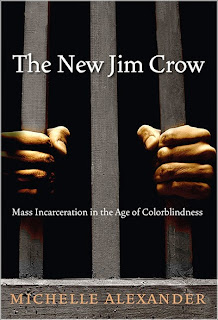
A democratic society requires mature, public conversation about issues of importance. Facebook CEO Mark Zuckerberg has convoked " A Year of Books " to offer such an opportunity. This commentary is part of a series of commentaries on each of the readings proposed by Zuckerberg. My commentary on Michelle Alexander's The New Jim Crow: Mass Incarceration in the Age of Colorblindness will have multiple entries for this truly remarkable book. This is the fourth of those entries. Having described something of the argument constructed by Michelle Alexander in The New Jim Crow in previous blog entries, here we will take a look at her stirring final chapter, "The Fire This Time." Alluding to James Baldwin's The Fire Next Time , a 1963 book consisting of a pair of essays. In this chapter, Alexander argues that only a major social movement to end mass incarceration with "an ethic of genuine care" for all persons will end the succession of racial caste s...

Known by Heart, or Bound in a Birdcage?

Image
A democratic society requires mature, public conversation about issues of importance. Facebook CEO Mark Zuckerberg has convoked " A Year of Books " to offer such an opportunity. This commentary is part of a series of commentaries on each of the readings proposed by Zuckerberg. My commentary on Michelle Alexander's The New Jim Crow: Mass Incarceration in the Age of Colorblindness will have multiple entries for this truly remarkable book. This is the third of those entries. Many know well the oration delivered by Martin Luther King, Jr. from the steps of the Lincoln Memorial. The vision cast on August 28, 1963 did not reach its fulfillment in King's lifetime. In fact, Michelle Alexander contends that the dream was cut short in the years shortly after the Civil Rights Act of 1964 and the Voting Rights Act of 1965 . At the heart of Michelle Alexander's The New Jim Crow is an argument: This book argues that mass incarceration is, metaphorically, the New ...

The New Jim Crow: Valjean and Today's Ex-Con

Image
A democratic society requires mature, public conversation about issues of importance. Facebook CEO Mark Zuckerberg has convoked " A Year of Books " to offer such an opportunity. This commentary is part of a series of commentaries on each of the readings proposed by Zuckerberg. My commentary on Michelle Alexander's The New Jim Crow: Mass Incarceration in the Age of Colorblindness will have multiple entries for this truly remarkable book. This is the second of those entries. Few things on stage have moved me more than when I first saw "Les Misérables." It was the summer of 1990 in Houston, Texas. Days before, I had devoured the novel by Victor Hugo. At various points during the stage show, I wept, perhaps none more than the final words of the musical: "To love another person is to see the face of God." The intertwined story of Inspector Javert, Fantine, Cosette, Marius Pontmercy, Gavroche, and, of course, Bishop Myriel, who, with an act of charit...

The New Jim Crow: A First Look

Image
A democratic society requires mature, public conversation about issues of importance. Facebook CEO Mark Zuckerberg has convoked " A Year of Books " to offer such an opportunity. This commentary is part of a series of commentaries on each of the readings proposed by Zuckerberg. My commentary on Michelle Alexander's The New Jim Crow: Mass Incarceration in the Age of Colorblindness will have multiple entries for this truly remarkable book. This is the first of those entries. The New Jim Crow  walks us through some of Zuckerberg's previous readings. An important element throughout Alexander's argument is the data about declining violence that inspired Steven Pinker's work (for example, p. 41). Sudhir Venkatesh 's mentor, William Julius Williams appears a couple of times (p. 34, p. 50). Venkatesh himself is cited in an endnote regarding Chicago's Robert Taylor Homes (p. 196).  George Orwell and doublespeak make an appearance, too (p. 131). While n...

Free-Market Advocate Takes Revenge on Orwell

Image
A democratic society requires mature, public conversation about issues of importance. Facebook CEO Mark Zuckerberg has convoked " A Year of Books " to offer such an opportunity. This commentary is part of a series of commentaries on each of the readings proposed by Zuckerberg. As an 8th grade student, back in 1983, in the run up to the year of the book's title, I read for the first time George Orwell's 1984 . That reading began a series of readings in dystopian and utopian visions, including Aldous Huxley's Brave New World  as well as a then unsuccessful foray into Thomas More's Utopia . Those darker visions, especially Orwell's, were vivid and haunting. Later, as a freshman in college, I believe, I read Orwell's " Politics and the English Language ," and I found a new mission in attempting to be a clear writer and thinker. Over time, my political vision has been driven more by hopeful visions of what we may become than by Orwell's h...