Posts

Setting upright that which had been knocked over

Image
For many, this post comes not as news but as unnecessary confirmation of what they already knew: Amor Towles' A Gentleman in Moscow is an absolutely delicious novel! Having seen recommendations from both my sister Andrea and Bill Gates, I purchased a secondhand copy of the book. Naturally, I relished the ample references to Russian and classical literature. Towles cites the oft-quoted line from Tolstoy's Anna Karenina : "Happy families are all alike; every unhappy family is unhappy in its own way," and then upends it in the telling of his story. Similarly, Towles introduces film and Humphrey Bogart. The Casablanca theme woven into the story is fantastic and inspires the title of this post. (I will refrain from saying more to avoid spoilers.) Towles' arresting, lush language and astute observations credited to the Gentleman (Count Alexander Rostov) invited substantial underlining of choice passages. I read more slowly than usual through this novel. Rostov,...

Untold Stories at the Periphery: Reflections on the Financial Crisis of 2008

Image
Image courtesy of PingNews.com  (CC 2.0) Throughout the media, I have been reading retrospectives on the "Financial Crisis of 2008," occasioned by the 10-year anniversary of the collapse of Lehman Brothers. It strikes me as odd that the touchstone event is so removed from those most adversely affected by the calamity. While I did not know it at the time, the seeds were sown many years prior. The first harvest of destruction was felt by America's vulnerable communities long before the earthquake on Wall Street. Beginning in 2001, I was an associate pastor at St. Stephen Parish in South Bend, IN. Fr. David Porterfield, C.S.C. and I had great hopes for how we could serve South Bend's west side. Gregorio Chavez approached me about opportunities to acquire abandoned properties adjacent to the parish through the county tax sale. Properties that had fallen behind on taxes were available through auction. Year by year, the lists became longer, growing as a many-paged su...

Buyer beware of Amazon Reviews

Image
When purchasing, I have often had my suspicions about online reviews of items. Now, I have a front-row seat for the scams associated. Opening my email this morning, Amazon sent me 20 "Thank you" emails for products that I have never purchased nor reviewed. All the reviews were written for relatively new products on the Amazon website. All the reviews were written between 2:14 a.m. and 2:46 a.m. (Central Time) when I was fast asleep. I have notified Amazon. The customer service agent said that the information was relayed "to the team trained to handle this scenario." The agent indicated that I should hear back in one to two business days. If a customer cannot trust the reviews (likely instigated by unscrupulous vendors), how can a customer trust a product? I will continue to update this post based on the actions taken by Amazon. Update #1: So far, Amazon's customer service is not living up to my previous experiences of them. A process was undertaken that...

Inequality and "The Broken Ladder"

Image
Wrestling with inequality shapes much of current political discourse, it seems, at home and abroad. If you pay attention, you have heard a great deal about growing pay and wealth disparities, the Gini coefficient , and other sundry items, in a growing number of articles and books. The Broken Ladder: How Inequality Affects the Way We Think, Live, and Die by Professor Keith Payne of UNC-Chapel Hill is an important contribution to this growing bundle of literature. Angus Deaton's The Great Escape: Health, Wealth, and the Origins of Inequality  established a powerful set of insights around income and life-expectancy, that health and wealth are two measures of quality of life, from the perspective of the economic sciences. Payne adds immense depth from his personal research and that of others in the field of psychology and neuroscience. Both Deaton (a Nobel Prize-winner) and Payne are fine scholars, and these two books are both eminently readable. Both have important scholarly ci...

Más sabe el diablo. . .

Image
It's a phrase of Mexican origin, I'm told:  " Más sabe el diablo por viejo que por diablo ." It translates to "The devil knows more because he is old than because he is the devil." Often, proverbs in our native tongue do not surprise us as they are so common. We may not think twice about an expression like "The apple does not fall far from the tree," but its use in another language requires an explanation of what the phrase implies. Because a phrase is well-known to us, it may not captures us quite the way that one from a second language might. Sometimes expressions are so particular that they only can be understood in a particular context. [Another wonderful Mexican phrase, " No me cae el veinte ," refers to a 20 peso coin getting stuck in a pay phone. The adage is a means of expressing that the speaker does not understand a concept that the other has shared-- just as the coin is stuck in the payphone and one cannot yet proceed with ...

That we may know Easter Joy

Image
Friends, I wrote for Catholic Relief Service's ethical trade blog earlier this week on the anniversary of the Rana Plaza disaster. The text is very much in keeping with the spirit of this blog site. The post on CRS is entitled:   That We May Know Easter Joy: Lament for Rana Plaza . It brings together authentically, I believe, my personal spirituality with that of my work at The Human Thread campaign. Please, feel free to comment here about the writing.

Join the campaign for Fair Trade and Sustainable Clothing from Kohl's and Macy's

Image
Between now and Black Friday (Nov. 25), The Human Thread calls for sending postcards to the CEOs of Macy’s and Kohl’s in support of a living wage at the sites where our clothes are made. I'd be grateful for your help. When we visit a supermarket, we can purchase organic and fair trade items. When we visit an auto dealer, we can buy a hybrid. Some chains build their identity and customer base by offering those options. We know that the hybrid and the organic, fair trade items may cost us a bit more, but we are willing to pay for them for a broader benefit. Except for a few niche clothing items sold in a few boutiques, as of yet, no major chain sells clothing sourced in other countries that is fair trade. But we know that most of it comes from places we read on our labels: Bangladesh, China, India, Vietnam, Honduras, Mexico. Pope Francis has called the wages paid those workers: “slave labor.” Given the woeful wages in garment-producing countries, did the workers who made ...

E.J. Dionne and the 2016 Election

Image
Last June, I reviewed E.J. Dionne Jr.'s Our Divided Political Heart: The Battle for the American Idea in an Age of Discontent . You can find the review here . I like Dionne, as a writer in The Washington Post and Commonweal , and I enjoy his contributions to MSNBC. Since 2004, Dionne writes a new book in a presidential election year-- 2004, 2008, 2012, and, now, 2016. Given my delight in his 2012 offering mentioned above, I sought out his 2016 title: Why the Right Went Wrong: Conservatism From Goldwater to the Tea Party and Beyond . As I delighted in his Our Divided Political Heart , I had high expectations for Why the Right Went Wrong . Frankly, it was a much more difficult read, likely not a reflection at all on Dionne's work. In fact, I think that it has much to do with me and how I find myself (and our country). I resided in Chile during the 2012 election. While I devoured the news that I could find via El Mercurio and my reading of Politico's Playbook and onli...

Thanks to MATC for hosting Bryan Stevenson

Image
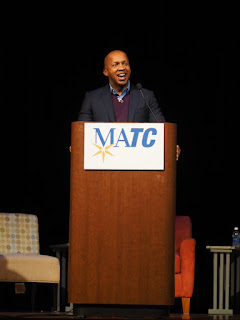
This afternoon, alongside nine other parishioners from St. Benedict the Moor, we attended a lecture by Bryan Stevenson at Milwaukee Area Technical College . Readers of this blog may recall that I reviewed Mr. Stevenson's extraordinary book, Just Mercy: A Story of Justice and Redemption last year. Others may know of my sister Kelly's work alongside the Equal Justice Initiative , defending those condemned to death in Alabama, founded by Stevenson in 1989. Stevenson gave an inspiring talk. I will avoid recounting his major points, as he has made some similar remarks elsewhere, and I believe that it is worth encountering him, his story, and his mission from him, be it through his book, his TED Talk, or an opportunity to meet him in person. Simply put, one cannot go away uninspired. His zeal is contagious. After his address, MATC also arranged for a short panel discussion in answer to what Stevenson's remarks. I have posted additional photos of the event on Facebook: http...

The Next Phase of the Journey

Image
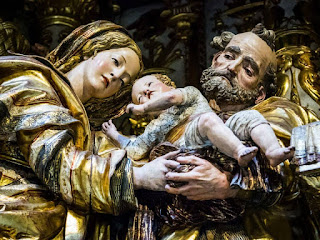
Friends, on Christmas Eve, amid many gifts, I was offered a job and accepted. Tomorrow, I begin the next phase of my journey as the campaign organizer for The Human Thread campaign . Tomorrow, I arrive into Milwaukee, WI, to begin my new work. The Human Thread is a campaign to raise consciousness and empower Catholics to advocate for the plight of garment workers worldwide. The movement was inspired by the 2013 collapse of the Rana Plaza factory in Bangladesh. The devastating event killed 1,133 garment workers, and exposed the wide range of abuses connected to the sourcing of clothing. I am grateful for the prayers and encouragement of so many in this process. I am also very grateful for the trust being placed in me by those of The Human Thread campaign. Thanks, too, to St. Joseph the Worker, a faithful friend amid these months of job-seeking. Holy Family at Burgos Cathedral, Spain PRAYER TO ST. JOSEPH THE WORKER (For employment) God our Father and our Creator, You bestow...

Top Ten Posts of 2015

Image
As 2015 draws to a close, I am filled with gratitude for the opportunity to share books and articles from others that have prompted reflections and thoughts, as well as sharing experiences from the my own journey here. While my weekly collection of "Four Articles and a Poem" draws a certain readership, I have excluded them from this list. Hence, many posts in this list are commentaries and reviews of books. I am especially grateful for the ways that readers have interacted with what I have posted here. Conversation is at the heart of he time that I put into this blog. So, I share a series of my ten favorite posts from the year, posts that help engage us in what I believe to be significant conversations. 50 Ideas for Making Laudato Si' part of Parish Life . My top post of the year is my most viewed and a post that has been subsequently published elsewhere. Pope Francis' Laudato Si' was such a landmark work, I enjoyed writing these  ideas on how to live the ...

Four Articles and a Poem

Image
Weekly, I share links to four articles that I found significant, accompanied by a poem. Our lives are enriched by seeing better. One article comes from the world of photography, a discipline intent upon shaping how we see. Another article takes up technology, hence seeing something of the future. Another takes up an aspect of our common life, seeing more clearly together. Another article refers to faith, seeing the unseen. Finally, the weekly post concludes with a poem, because poetry is about seeing words whose arrangement allows us to see anew. So close to Christmas and its cheer, let me address the darkness not caused by the short days. Making War Make Sense, Mathematically . Sanjena Sathian, writing for Ozy, profiles Kiwi physicist Sean Gourley . By analyzing raw data on violent incidents in the Iraq war and others, Gourley discovered strong mathematical relationship linking the fatality and frequency of attacks, an algorithm for conflict and war. His TED Talk is short,...

The Marvels of Murdoch Mysteries: Characters, History, Science, and Faith

Image
I do not watch much television. I have a few favorites like The Daily Show. I watch news. I am not heavily invested in television series. Nonetheless, I love Murdoch Mysteries . I got into it when I spent some time in Canada last year. Subsequently, Mom DVRs it each week on the local PBS station, and we have watched other seasons borrowed from the public library. Murdoch Mysteries is a Canadian television drama series aired on both City and CBC Television, titled The Artful Detective on the Ovation cable TV network, featuring Yannick Bisson as Detective William Murdoch, a police detective working in Toronto, Ontario, around the turn of the twentieth century. Murdoch Mysteries was initially adapted for television from Maureen Jennings ’s popular Detective Murdoch series of novels as three made-for-TV films broadcast in Canada in 2004 and 2005. The series first premiered in Canada in January 2008. Detective Murdoch is conspicuously Catholic. As he arrives at the scene of each hom...

Blessed, indeed, are the Organized

Image
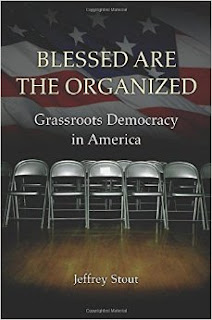
I may have a new first book to recommend to folks about the nature of community organizing. Often, I suggest Dennis Jacobsen's Doing Justice: Congregations and Community Organizing as a first book to read. I once kept a small box of Jacobsen's book in the car to give to key people when we were trying to build an organization in South Bend, IN. This weekend, I finished reading Jeffrey Stout's Blessed are the Organized: Grassroots Democracy in America , the likely replacement to Jacobsen's fine work. To begin with, I love the title: Blessed are the Organized . Invoking the Beatitudes gives a pithy, novel explanation to the purpose of organizing. The Beatitutdes, as spoken by Jesus and related in the Gospels, tells of a "blessing" given to those who, for their current condition, appear more bereft than blessed. We organize that our lives might know a blessing that we do not currently experience. The book derives its form from the fortuitous suggestion of Sta...

The Idea Factory: Industry, Monopoly, and Creativity

Image
Mature, public conversation about issues that matter is foundational for democratic society. I am delighted that Mark Zuckerberg's " A Year of Books " offers such an opportunity. To contribute to that dialog, I will offer commentary on each of the readings proposed by Zuckerberg. There is something fascinating about old buildings, especially big, industrial style buildings. "Old," as a word, is rather vague, in this sense, occasionally something quite distinct from the chronological. Seeing old factories, like the remnants of the Studebaker factory in South Bend, hint at bygone days of industry. I have wanted to understand these buildings, and the people who once inhabited them. Jon Gertner 's The Idea Factory: Bell Labs and the Great Age of American Innovation is a marvelous introduction to the people and spirit and place of Bell Labs . It breathes with more than nostalgia for this earlier era. Published in 2012, The Idea Factory tells the history ...

Four Articles and a Poem

Image
Weekly, I share links to four articles that I found significant, accompanied by a poem. Our lives are enriched by seeing better. One article comes from the world of photography, a discipline intent upon shaping how we see. Another article takes up technology, hence seeing something of the future. Another takes up an aspect of our common life, seeing more clearly together. Another article refers to faith, seeing the unseen. Finally, the weekly post concludes with a poem, because poetry is about seeing words whose arrangement allows us to see anew. This week, we begin by examining the budget-making process of the U.S. Federal government. Do not yawn yet; there are valuable treasures in the article. Then, under science, we see how Nobel laureates look at dollars and the literal death of the middle class. Under the faith heading, we consider the #BlackLivesMatter movement, and in photography we visit Our Lady of Guadalupe on her feast. Our poetry as well underscores this beautiful feas...

Who teaches the practice of democracy to our youth?

Image
Since I have returned to the U.S., I have repeatedly heard expressions of frustration, disregard, and even dismissal of American youth because they do not vote. In June, the U.S. Census declared that Millenials now outnumber Baby Boomers . While their lack of voting is troubling, frankly, I do not think that the problem is with American youth, Millenials or younger; the problem runs much deeper. For some, the practice of democracy is little more than to inform oneself about the issues and the candidates, to vote in primaries and elections, and to contact elected representatives (via letters, letters to the editor, emails, online petitions, Facebook shares, and Twitter hashtag campaigns, or any other means that may come along). If these are the obligations, and so few achieve even these modest goals, it seems foolhardy to expect more. 11 9 07 Voter Apathy Bearman Cartoon Used with permission Our modern political parties do not seem to help. Mostly, we receive emails generated on...

Neumark's "Hidden Inheritance" is a must read

Image
Craig Dykstra , then at the Lilly Endowment, now at Duke Divinity School, first recommended reading Neidi Neumark's Breathing Space: A Spiritual Journey in the South Bronx , and I bought it a few days later in 2008. It is one of the few books to make both the journey down to South America with me and back to the North again. When I saw that Neumark had a new forthcoming book, Hidden Inheritance: Family Secrets, Memory, and Faith , I made arrangements to have it shipped as soon as possible. Yesterday morning, I finally pulled it from a stack of books on my dresser. It was the perfect tonic for all that besets us this day. I read it straight through, interrupted only by visits to the coffee maker, an email to the author, and my mother's inquiries as she decorated at the Christmas tree. Neumark discloses very early in the book, so this is not a "spoiler," that unbeknownst to her, her father's family was Jewish and suffered in the Shoah (the Hebrew term for wha...

Obstacles to Retaining the Creative Class

Image
Some years back, I asked an urban planner of the city of South Bend for some recommendations in his chosen profession. After Jane Jacobs and her 1961 classic The Death and Life of Great American Cities , he recommended reading Richard Florida, and I quickly picked up and read The Rise of the Creative Class from 2002. Now, more than a decade later, I come to his 2006 follow-up The Flight of the Creative Class: The New Global Competition for Talent . Richard Florida, the director of the Martin Prosperity Institute and professor at the University of Toronto's Rotman School of Management, researches the social, economic, and demographic factors that drive the contemporary world economy. In The Rise of the Creative Class , Florida argues that those whom he describes as the creative class are a key driving force for economic development of post-industrial cities in the U.S. Cities like Austin, Chapel Hill, Portland (OR), San Francisco, Seattle, and Washington, D.C. exemplify...

Four Articles and a Poem

Image
Every week, I share links to four articles that I found significant, accompanied by a poem. Our lives are enriched by seeing better. One article comes from the world of photography, a discipline intent upon shaping how we see. Another article takes up technology, hence seeing something of the future. Another takes up an aspect of our common life, seeing more clearly together. Another article refers to faith, seeing the unseen. Finally, the weekly post concludes with a poem, because poetry is about seeing words whose arrangement allows us to see anew. This week, we will look at what role faith may play in reducing gun violence. We will examine the science around soil loss and the politics of climate change in Paris. We will look at a photographer who documents gun violence in life-giving ways. Finally, we will hear from Rudyard Kipling as he mourns his son. Can Faith-Based Organizing for Gun Control Work? With the San Bernardino tragedy this week, on top of so many, and the #thou...